Carbon Capture, Utilization and Storage (CCUS) technologies enable the reduction of industrial CO₂ emissions, supporting the decarbonization of complex sectors.
What are CCUS technologies and how do they work?
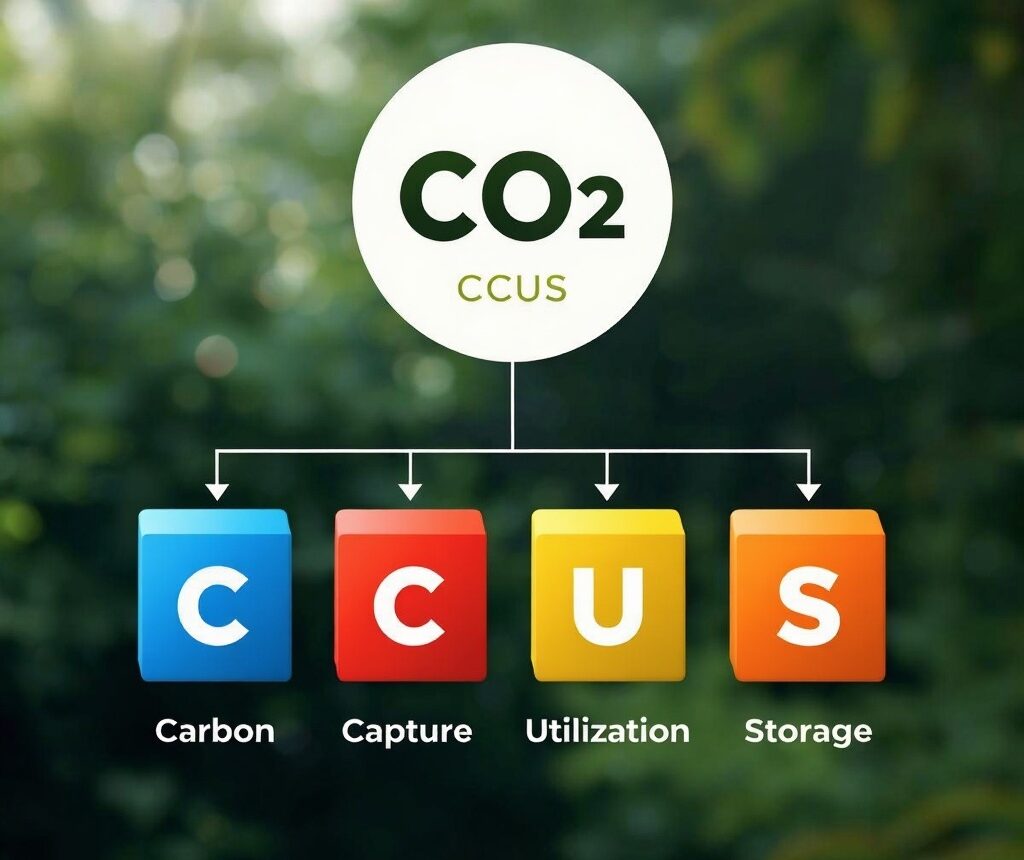
Carbon Capture, Utilization and Storage technologies, known by their English acronym CCUS, are a set of processes that capture carbon dioxide (CO₂) generated by industrial or energy facilities before it reaches the atmosphere. This carbon can be safely stored in deep geological formations or used in productive processes, thereby reducing the net emission of greenhouse gases.
The complete CCUS process is structured around three main phases:
- Capture: separating CO₂ from combustion gases or industrial emissions.
- Transport: transporting the captured CO₂ to a storage or use site via pipelines, trucks, or vessels.
- Utilization or storage: using that CO₂ in industrial applications or injecting it into deep geological formations for permanent storage.
These technologies play a particularly important role in sectors where emissions cannot be eliminated easily through electrification or the use of renewable energy, as is the case in the production of cement, steel, and chemicals.

Why are CCUS technologies critical for decarbonization?
As countries and companies commit to net-zero emissions targets for 2050, significant technical challenges arise for industries that rely on carbon-intensive processes. Although electrification and energy efficiency reduce a significant portion of emissions, a considerable volume of CO₂ that is difficult to avoid still remains, known as “hard-to-abate emissions”.
CCUS technologies offer a complementary solution by enabling the capture of residual CO₂ and preventing it from reaching the atmosphere. This not only contributes to reducing the carbon footprint of existing operations, but also enables the continuity of fundamental industrial processes while cleaner alternatives are developed, in line with the current challenges of industrial decarbonization.
Furthermore, the captured CO₂ can be used as a raw material to manufacture new products, which opens commercial opportunities and fosters a circular carbon economy. For example, CO₂ can be converted into synthetic fuels, construction materials, and chemical inputs, reducing dependence on traditional fossil sources.
Industrial Applications: CCUS Use Cases
CCUS technologies are integrated into various industries with varying results. In the cement industry, for example, conventional processes release CO₂ both from combustion and from the chemical reactions needed to manufacture clinker. Capture solutions allow part of these emissions to be captured at source, reducing the overall production impact.
These principles also apply in the production of low-carbon fuels, where captured CO₂ is transformed into e-fuels (synthetic fuels) by combining it with green hydrogen. In this context, CCUS technologies not only reduce emissions, but also enable new energy products with a low carbon footprint that can replace conventional fossil fuels.
It is important to note that, although some sectors are advancing faster than others in adoption, the international community recognizes that expanding CCUS projects will be necessary to meet the climate targets of 2030 and 2050, especially in economies with heavy industries dependent on carbon-intensive activities, as noted by the International Energy Agency (IEA).
Technical and Economic Challenges of Implementation
Despite its potential, CCUS technologies face significant challenges that constrain their large-scale deployment. The carbon capture component is the most technically complex, as it requires advanced CO₂ separation systems and high energy levels to operate.
Furthermore, the construction of infrastructure to transport and store CO₂ entails high investments and coordinated planning between companies and governments. The availability of suitable geological sites for permanent storage is also a key factor in ensuring the effectiveness of the process.
From an economic standpoint, the cost of implementing CCUS projects can be a barrier without public incentives or market mechanisms that internalize the climate value of reducing emissions. For this reason, many countries are developing support policies, tax credits, or carbon pricing schemes to stimulate investment in these types of technologies.
Integration with Other Climate Strategies
CCUS technologies do not act in isolation. To achieve deep decarbonization, it is necessary to work by combining these solutions with other complementary strategies, such as energy efficiency, the use of renewable energy, and the electrification of industrial processes.
Furthermore, many industries are exploring forms of direct air capture (Direct Air Capture) and low-carbon hydrogen production, which can work synergistically with CCUS to further reduce global emissions. This broader approach not only reduces the carbon footprint, but also promotes innovation in emerging decarbonization technologies.
The Role of CCUS in the Transition Toward a Low-Carbon Industry
CCUS technologies are emerging as a key tool for addressing emissions that cannot be eliminated solely through electrification or renewable energy. Their ability to capture and manage CO₂ enables progress in the decarbonization of industrial sectors without compromising their operability.
Although technical, economic, and regulatory challenges still exist, its development will be decisive in the coming years to meet global climate objectives. In this context, the integration of CCUS within industrial and energy strategies will be a determining factor in building a more sustainable and competitive productive model.
The ability to integrate these solutions into real productive models will make the difference between a theoretical energy transition and effective implementation in industrial sectors.

¿Buscas una empresa experta en proyectos innovadores y sostenibles?
¿Buscas una empresa experta en proyectos innovadores y sostenibles?